The Whistler community cares deeply for the environment and acknowledges that we all have a role to play in preserving the area’s natural beauty. The Municipality’s Big Moves Strategy sets out a plan to act on climate change and reduce emissions by 50% below 2007 levels by 2030, and in the long term, reach net zero. To achieve this target, Whistler is collectively taking action to move beyond the car, reduce visitor travel emissions, decarbonize passenger and commercial vehicles, reduce building emissions, and shift towards lower carbon consumption.
We know that this kind of work is an ongoing journey as we all learn how we can contribute to a more sustainable future. Join our Changemaker host, Mike Douglas, a member-at-large of Protect Our Winters Canada, pro skier, enviro nerd and Whistler local, as he shines a light on what’s happening in Whistler to move the dial.
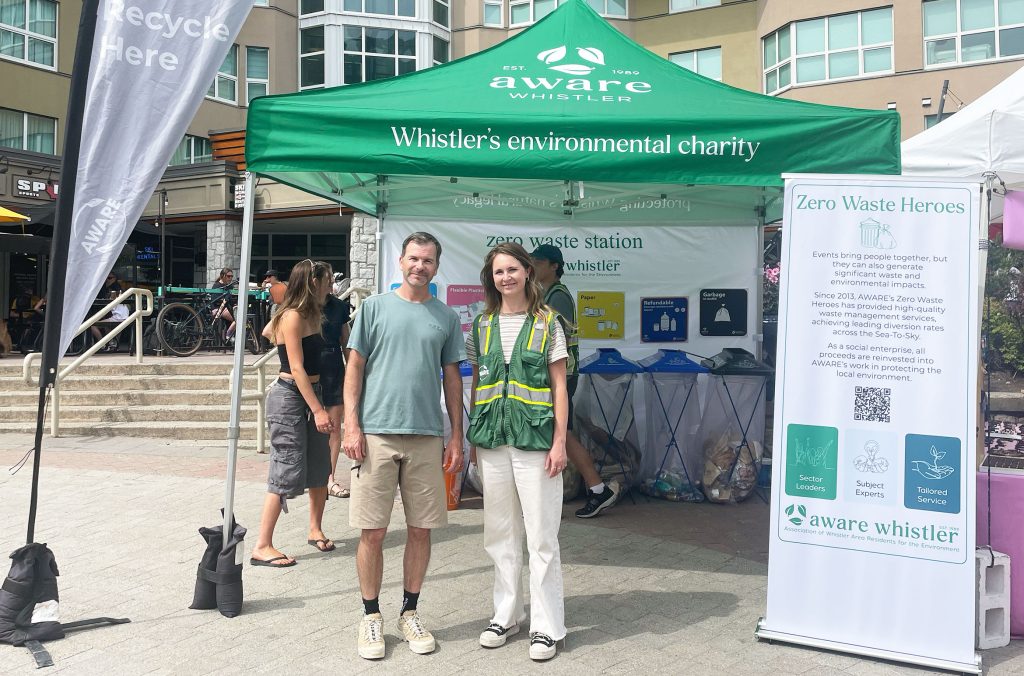
In video #8, we touch base with Kirsty Smyth, Zero Waste Program Manager at AWARE Whistler. She chats with Mike about composting, local recycling and shifting our buying thought process.
What is AWARE and the Zero Waste Heroes Program?
AWARE is Whistler’s environmental charity. Since 1989, we have led climate action, conservation and circular economy initiatives for the local community. Zero Waste Heroes is AWARE’s social enterprise, helping events to achieve their zero waste goals. Last year, over 23,000 people engaged with AWARE’s Zero Waste Heroes program in Whistler, at events, in the parks, and at the Farmers’ Market.
Events bring people together, but they can also generate significant amounts of waste and put pressure on our natural environment. Through the Zero Waste Heroes service, AWARE helps visitors and residents enjoy the events that make Whistler special, while encouraging everyone to leave as little behind as possible. We work with event organizers to provide waste reduction and diversion support, including event planning, on-site waste sorting, and post-event reporting and analysis.
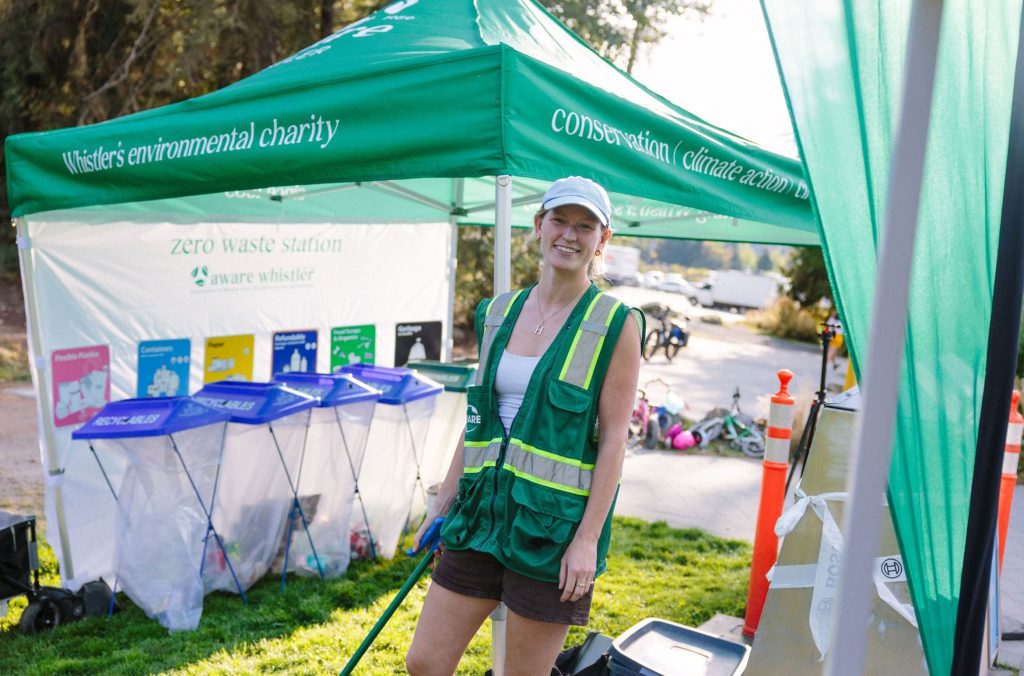
Zero Waste Heroes is a social enterprise, so when events use us, the money generated goes back into environmental initiatives in Whistler, like our youth engagement programs and our local advocacy work. We have leading waste diversion rates, and our team is highly trained to provide guidance and education to businesses and guests.
Do events have a big waste footprint?
Yes, but we can work with them before, during and after their event to reduce it. Last year, we helped GranFondo and Arc’teryx Academy become Zero Waste Events, which means that over 90% of their waste was diverted from landfill.
We work on waste prevention first by influencing what can and cannot come into the event area. Reusables are our go-to, but if that’s not possible, we can help source compostable options. That way, we have more control over the waste diversion outcomes.
We also gather lots of data from each event so that we can report back to organizers on what is going well and where there is room for improvement. This means that many of the events that we work with reduce their waste footprint year over year.
How do you get people to trash-talk with you?
It’s mostly easy! People want to do the right thing, but recycling can be confusing. We guide people to the right place when we’re at an event, but we’re also talking to them about better choices for the future.
A lot of people ask us, “Doesn’t it all end up in the same place?” and the answer is, not here! British Columbia has amazing recycling systems; we just need to use them. For example, 99% of the plastics sent to Recycle BC in 2025 went to manufacturers that give recycled materials another life.
Why is composting so important?
One of our top goals is to keep compostables and food waste out of the landfill, because it gets trapped and causes methane, which is significantly more harmful to the environment than carbon dioxide. But if food waste is placed in the organics stream, it can be repurposed locally as soil, adding to a circular economy.
Whistler’s landfill waste is transported to Cache Creek (about 450 kilometres, routed via Vancouver), and so if organic waste is separated and composted within our community, emissions associated with hauling are also reduced. Last year, 39% of Whistler’s landfill waste could have been composted; so we’ve got some work to do!
What can people do?
If Whistler is going to hit its Zero Waste target by 2030, we need an informed and engaged public. We want people to think about the end of its life at the start. If you pick up something and know it will end up in a landfill, ideally, you reconsider your decision and pick something that can be reused or composted.
If you are not sure whether an item can be recycled, or which stream it belongs in, Recycle BC’s Waste Wizard is an excellent resource to help you understand what goes where. You can also come and say hello to one of our Zero Waste Heroes when you see us out and about in the community – we are always happy to help!
How does the Zero Waste Heroes program contribute to the Big Moves Strategy?
Whistler’s Big Move 6 focuses on closing the loop and shifting towards low-carbon consumption. Through the Zero Waste Heroes program, AWARE helps residents, visitors, event organizers and vendors make better choices about waste and resource use. We help identify simple opportunities to reduce waste, improve diversion and minimize the environmental footprint of events in our community.
This AWARE Whistler video is the eighth in the Whistler Changemaker series. To view more, visit our sustainability page.