Whistler is defined by many things. Its landscape. Its sports. Its spirit. Its culture. And its attitude of inclusivity.
Whistler prides itself on its open, welcoming embrace of diversity: orienting its continued development to ensure that the town and trails are not just geared towards the able-bodied, but, rather, all bodies.
The Resort Municipality of Whistler (RMOW) is the first to declare that “Accessibility is an evolving concept that will always have room for improvement. It is a journey and not a destination.” However, it is a journey that the RMOW has actively embarked on, as have Whistler Off Road Cycling Association (WORCA) and Whistler Blackcomb, spearheading the implementation of accessible and/or adaptive infrastructure developments and modifications.
Adopting Accessibility Frameworks
Starting in the 2000s, and especially after the 2010 Paralympic Winter Games, “Whistler began applying formal accessibility frameworks,” according to the RMOW. “The municipality now uses Universal Design principles (design usable by all people without adaptation).”
Accessibility is integrated into policies in the Resort Municipality’s Official Community Plan (OCP), and a proactive Whistler Accessibility Action Plan (2022+) guides decision-making. Whistler is modelling some of the most innovative strategies for enlarging the continued scope of access to this mountainous landscape.
The Pre-Planning Preparation
“The best thing that we can do,” Whistler Blackcomb relays, in their attempts to foster a barrier-free experience to guests who have accessible needs, “is provide as much pre-arrival information as possible so people can make informed decisions and plans.”
The Mountains have an ‘Accessibility in Whistler’ webpage, a mountain bike orientation guide, videos and specific signage (both on the mountain, in their related retail outlets and throughout their website). All of these combined resources allow people to plan ahead and ease their arrival and overall experience.
Access Whistler Map
Not all visitors to Whistler wish to go up the mountain to ride, wander the trails or go sightseeing. Many choose to stay in the Village and Valley. And, here too, there are resources and options for exploration. The RMOW has produced an Access Whistler Map which shows the various elements of accessible infrastructure throughout the Village.
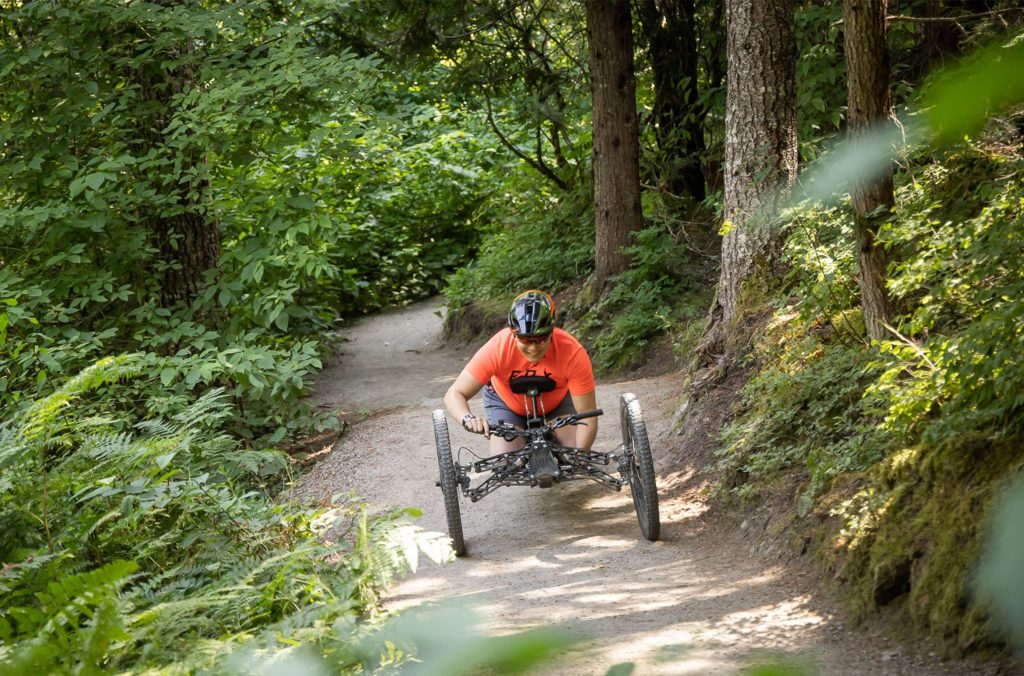
For accessible mountain biking trails (aMTB) throughout the Valley, both WORCA and the RMOW steer people toward online platforms such as Trailforks, where people are guided to select ‘Adaptive MTB’ as the filter for ‘Bike Type’. The list of trails included continues to expand.
Whistler’s Accessible Trails
From gentle sidewalk-cruising to wheelchair-wide and grade-appropriate wooded trails, to daredevil descents: Whistler offers a network of trails to meet a diversity of needs and dreams.
The Whistler Valley Trail
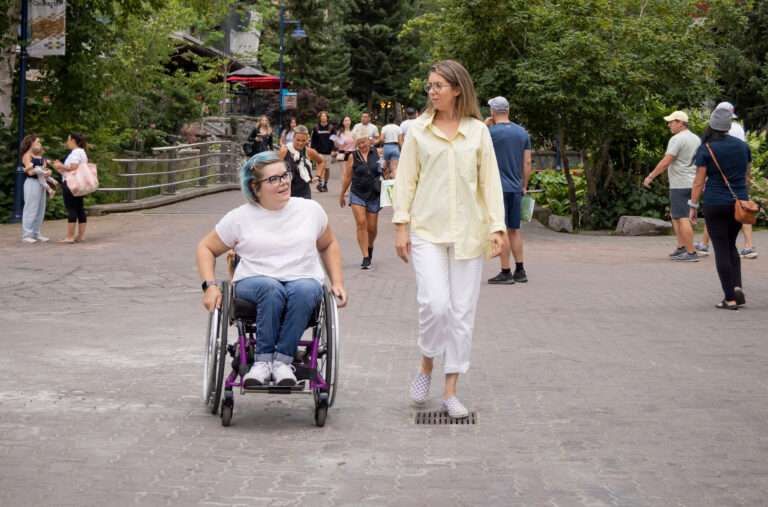
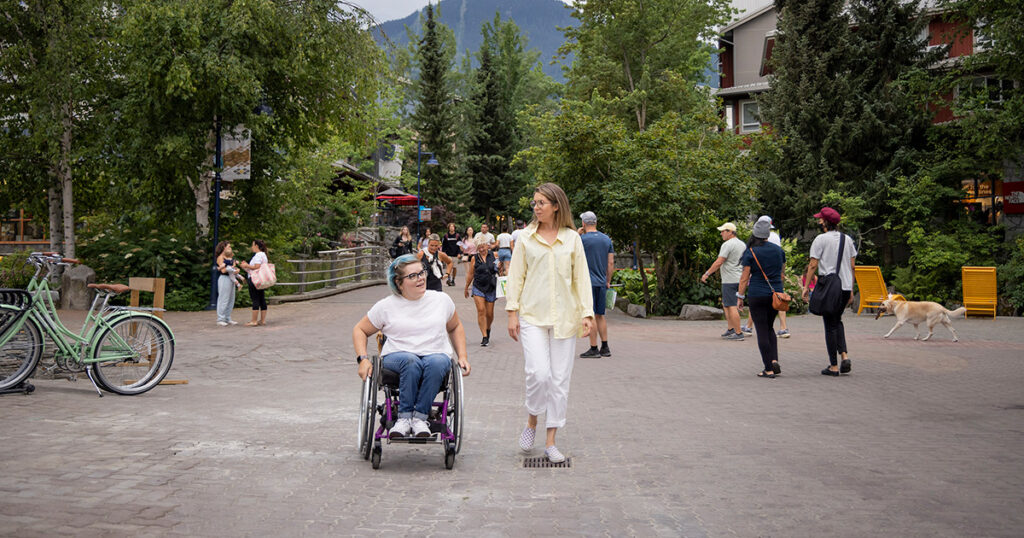
“The Valley Trails are amazing,” exclaims athlete and community accessibility advocate Olivia Rey. A wheelchair user, Rey continues, “You can basically go from like Emerald all the way to Function on the Valley Trail.”
The Whistler Valley Trail was designed as a multi‑use, low‑grade, paved greenway, not a rugged trail, linking all the neighbourhoods from one end of Whistler to the other:
“The RMOW recognizes that the Valley Trail is not uniformly barrier‑free; some segments have steeper grades (e.g., up to 12%) or uneven access points. As a result, the Accessibility Action Plan seeks to have LIDAR data added to the GIS to better inform community members and visitors of what sort of grades they should expect when travelling certain sections of the Valley Trail.”
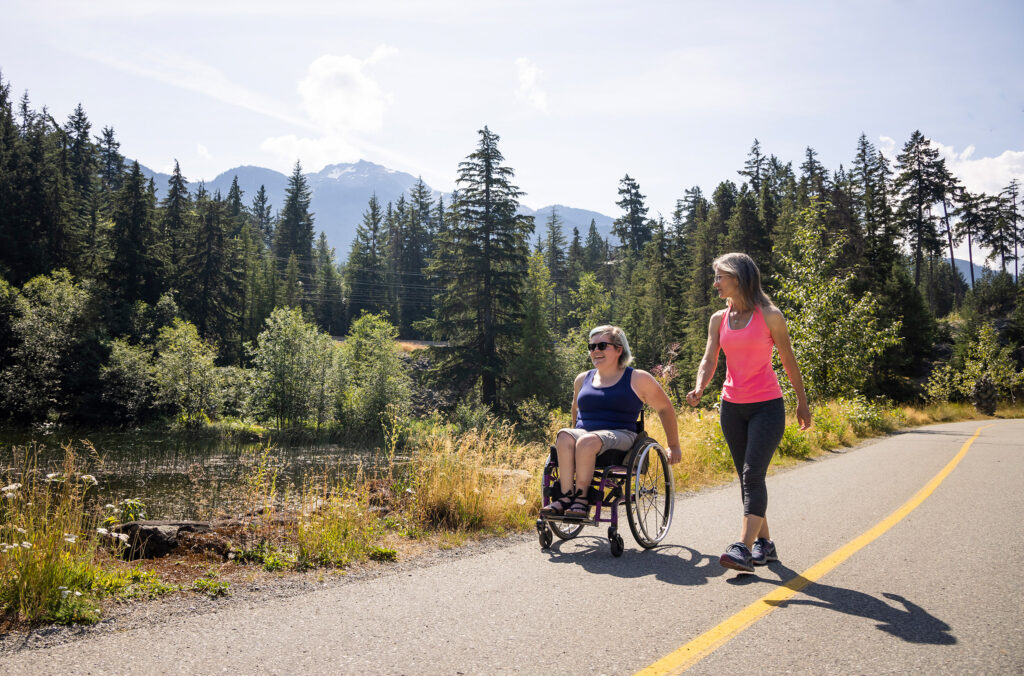
The Valley Trail system exemplifies multi-modal, shared usage: from strollers to bikes, four-wheelers to trikes, walkers to wagons, the trail winds past a myriad of local sights, from woods to waterways.
The Valley Trail can be accessed at various points throughout Whistler, with maps, information signs and historical interpretative panels dotted along the way. Sporadically painted along the path are friendly invitations and reminders to ‘Share the Trail.’
Fitzsimmons Accessible Nature Trail
Located north of Lorimer Road between Fitzsimmons Creek and Blackcomb Way, the trail is considered a Universal Access Trail. The RMOW relays that:
“The construction of this trail included re-surfacing and compacting, removal of vegetation to improve sight lines and safety, and installation of interpretive signs. Though this trail was purposely designed for universal mobility, we recognized that there is an opportunity for people with vision impairments to experience the trail with some modifications, as well as improvements for the interpretive signage for people with vision loss.
We also ensured that the trail met DeafSpace requirements to allow individuals who use sign language to converse without needing to break visual contact while moving through the wide spaces with clear sightlines and a smooth barrier-free circulation.”
The Trail offers an excellent opportunity to experience some of the biotic diversity of the local ecosystem, offering the chance to glimpse a multitude of the local flora and fauna, from birds to beaver-bitten trees.
Whistler Blackcomb’s Mountain Biking Trails
“Our mandate is to ensure that the trails and the experiences that we have are accessible to as many people as possible,” states Omer Dagan, Whistler Blackcomb spokesperson and Senior Analyst. “Our goal is to ensure that the mountains are open to everyone, that anyone, regardless of their ability, age, or background, can come to Whistler Blackcomb and have a great experience.”
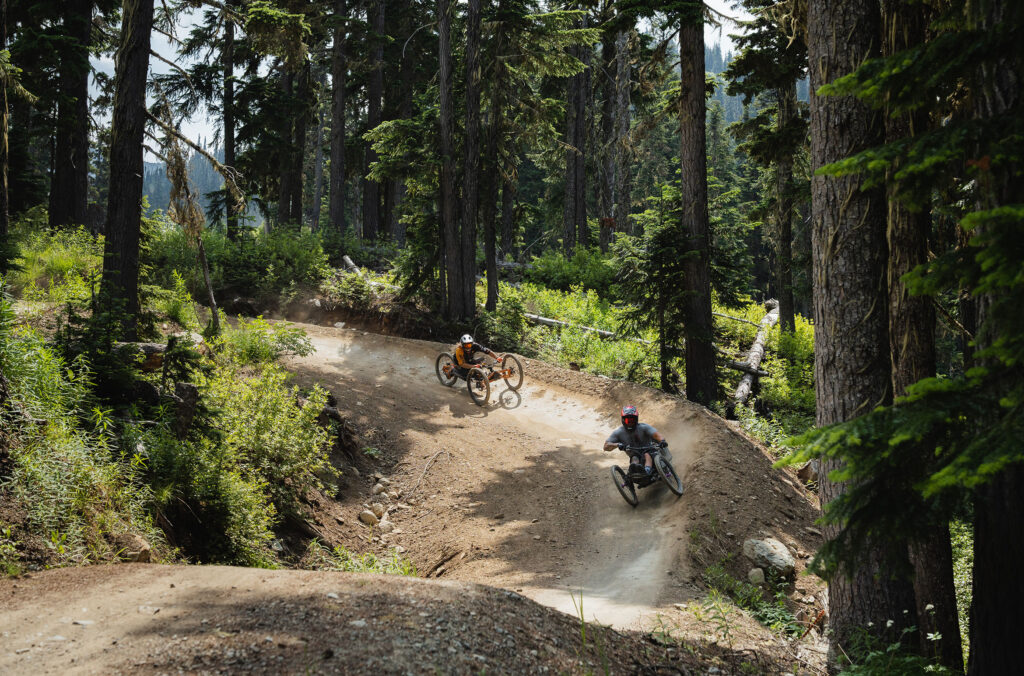
Directing us towards the MTB trail map, Dagan notes that about 50% of the bike park trails have received an adaptive rating. There are adaptive green trails, blue trails and yes, even multiple black diamonds. These are all represented by icons on the Mountains’ Trails Map. Whistler Blackcomb employs the Kootenay Adaptive Mountain Bike Trail Rating System, a leader in the field of accessibility, to assess and rank its trails.
Whistler Blackcomb has offerings that cater to the beginner right up to elite, world-class, competitive adaptive athletes who use the Mountains’ trails as a training ground.
“The absence of a sign [on the map] simply means that we have not rated that trail. It doesn’t mean that it’s not accessible.”
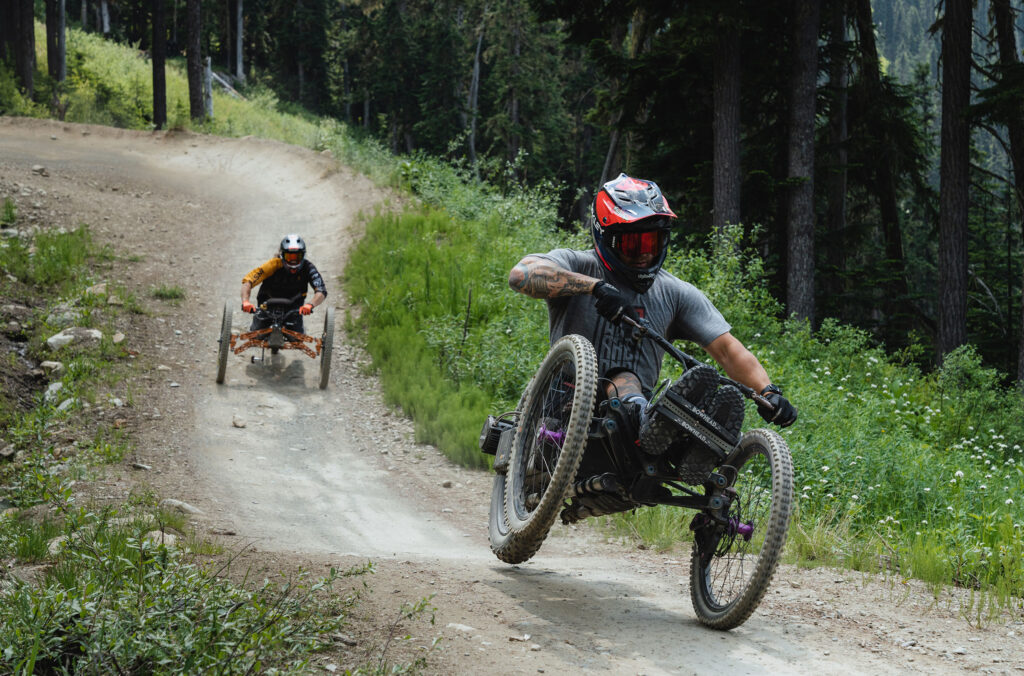
Whistler Blackcomb is at the forefront of accessible initiatives, with an internal accessibility working group with representatives from all departments. The Mountains has also “created an adaptive mountain bike lift loading video so that folks who are here in the resort can understand how we’re going to load their adaptive mountain bike for them on the gondola or the chairlift.” Whistler Blackcomb has predefined training for all of its lift operators.
“Our level of understanding of what is a best practice has really shifted. We recognize that we are not perfect and we have a lot of work to do and a long way to go.”
That being said, the Roundhouse, however, is the first facility at any resort in North America to be certified accessible by the Rick Hansen Foundation. This designation and recognition are an important stepping stone on the trail ahead.
Valley-based, Off-road Mountain Biking Trails: Flashback, FarOut, Farside
WORCA’s visionary mandate is to “deliver a world-class trail experience that meets diverse community needs.” Lead trail builder Dan Raymond excitedly exclaims: “It’s been one of the most fun parts of my job to imagine what the [trail] network could be, and this adaptive lens is just like one other way to look at what’s available [and] actually meet more needs or the needs of more people.”
WORCA’s current strategic plan includes focusing on new trail development that addresses “gaps in the existing trail network (e.g. adaptive trails, climbing trails) with the goal of building cohesive loops.” And an 11-kilometre cohesive loop, meeting adaptive accessible standards, is exactly what WORCA, in conjunction with the RMOW, is in the process of completing in the Cheakamus Trail network.
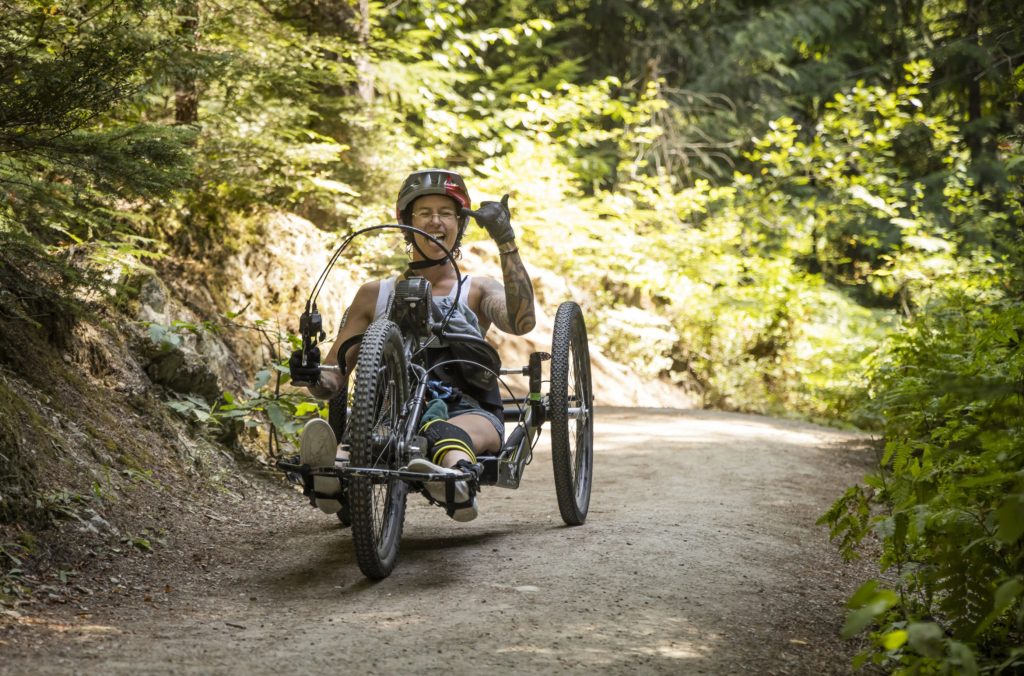
Construction began in 2023 on WORCA’s first aMTB trail, the Flashback 1 segment. Construction has continued. WORCA Executive Director, Trevor Ferrao, explains, “This year… will result in a complete 11-kilometre aMTB route using Farside, Far Out and Flashback trails.” The excitement is palpable, as Raymond, Ferrao and the WORCA crew work towards the end of this multi-phased project. The passion is clear, as is WORCA’s dedication to the continued building of more accessible trails.
Raymond expresses how he gets “really excited about growing the mandate” and is quick to point out that “just because the trail is adaptive blue-rated doesn’t mean that blue able-bodied bikers won’t appreciate and want to use that trail as well.”
Next Steps for Accessibility in Whistler
The RMOW “recognizes that much of the early efforts to improve accessibility related to mobility disabilities and that continued efforts are needed for individuals with vision loss, those who are Deaf and hard of hearing, as well as for individuals with cognitive disabilities.” The Municipality is currently looking at some technology interventions that may assist individuals with disabilities through their smartphones.
From Crankworx to the Invictus Games, from Whistler Adaptive Sports programs to roundtables, advocacy committees and policy changes, Whistler continues to model integrating effective accessibility mechanisms not as an afterthought, but as paramount, recognizing, all the while, that collectively we still have much to learn, undo and re-do. Upgrading and addressing more accessible public transportation to/from and within Whistler necessarily needs to be prioritized, along with access to accessible accommodation (both for residents and visitors alike).
The RMOW adds, “We will continue to evaluate our trail system and make improvements to allow everyone to participate and enjoy the beautiful natural environments of Whistler.”
Olivia Rey perhaps best sums up an integral takeaway, with her reminder that…
“Being in a wheelchair doesn’t define who I am as a person. It’s simply the way that allows me to move through the world, similar to how someone rides their bike, skateboard, or car.”
A broadly accessible Whistler is a vision we can all participate in realizing.