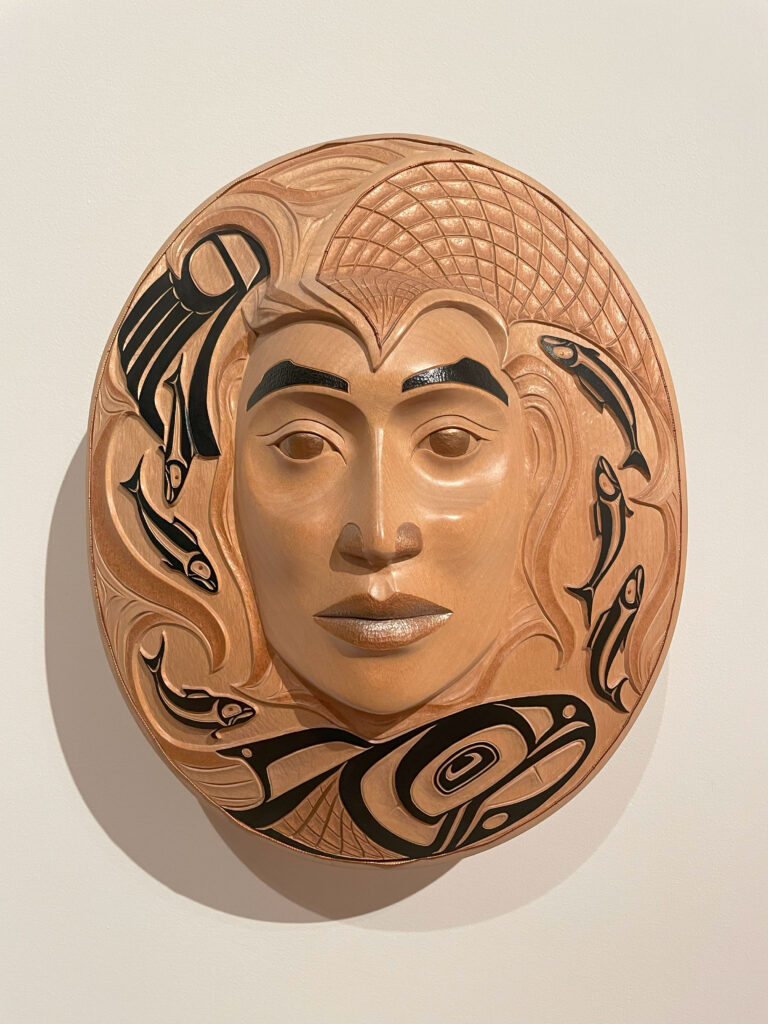
I stare into the copper-coloured eyes of a woman with canoes for eyebrows, a fishnet woven through the top of her hair that flows like a river where salmon swim and jump. The light hits the contours of her face, delicately carved into a single piece of silver birch. She’s beautiful, serene yet powerful, and I know there’s a story behind those eyes that I can’t tear my own from.
I’m describing Arlene Ness’s carving based on the legend of the Copper Woman, who was respected and admired for her connection to the Salmon People.
“When I carve faces, I carve my ancestors, and the Gitskan spirits. Each carving represents ancient Gitskan legends and family lineage, which is proprietary knowledge held as history by my people.” – Arlene Ness, quote from the exhibit’s dedicated book by Figure.1 publishing, available for purchase at the Audain Art Museum.
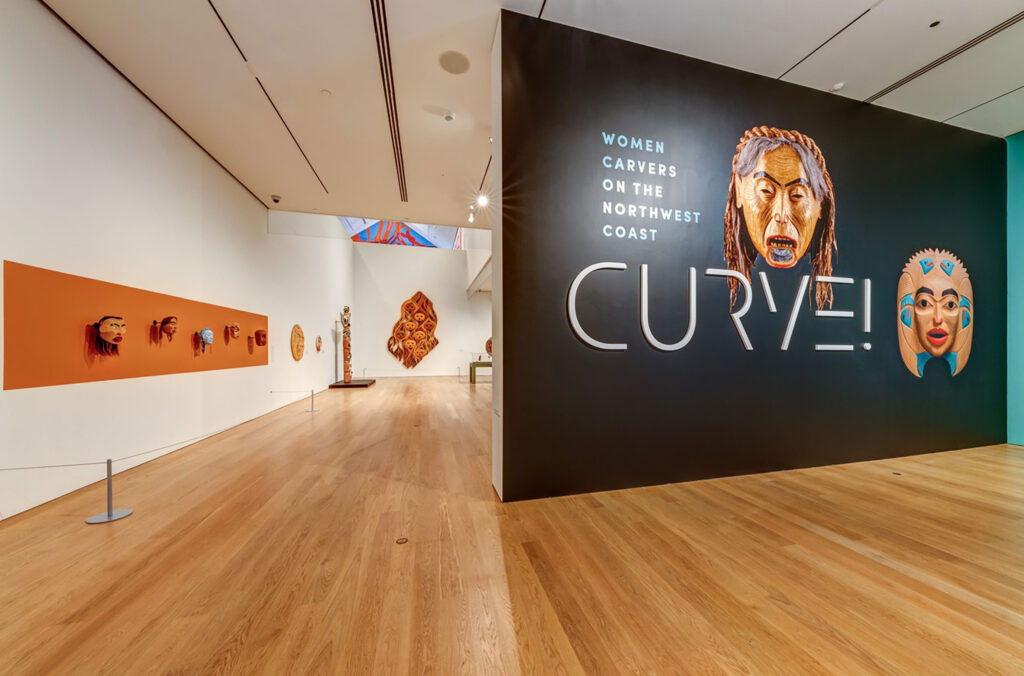
Ness’s carving is one of 127 pieces that make up the CURVE! Women Carvers on the Northwest Coast exhibit at the Audain Art Museum until May 5, 2025. Spanning 80 years of artistry, 14 Indigenous women carvers from the Northwest Coast showcase their works including masks, sculptures, poles, panels and bowls.
Curators Dana Claxton, an artist, filmmaker and professor from Wood Mountain Lakota First Nations in Saskatchewan, and Curtis Collins, the Audain’s director and chief curator, took two and a half years to put this exhibit together bringing overlooked Indigenous female carvers into the light.
Claxton and Collins chose to mix emerging and mid-career carvers alongside revered names like Freda Diesing, Ellen Neel and Doreen Jensen. Although I did just use the word revered, the names of these incredible female carvers have been left out and under-acknowledged in the art world thus far, but times, as ever, and thankfully, are changing.
“The idea came from Dana Claxton, who has been watching some of the carvers in the show as they’ve progressed over the last decade. At the same time, I’d become more aware of the work and importance of carver, Freda Diesing through the exhibit we did with Dempsey Bob,” explains Collins.
“For the last 200 years, the study of the Indigenous peoples of the Northwest Coast has been the exclusive domain of anthropologists, who look at the world through a scientific lens. They tend to categorize things and, in this case, the pervading categorization is that men carve and women weave. Many pieces in museums around the world lack information about the artist, who is then presumed to be male. But the CURVE! exhibit challenges that perspective with the truth that women on the Northwest Coast have been carving for centuries.
The lineage of the pieces displayed spans generations and highlights the passing of knowledge from one carver to another. Some of the newer artists in the exhibition came through the Freda Diesing School of Northwest Coast Art (part of Coast Mountain College) and are incredibly impressive.
We use our temporary exhibits to highlight where we can do better within our permanent collection. We realized that the masks we display are all by male artists and carvers, and we’re going to change that. We want the Audain to be a forward-looking institution that stretches and bends the traditions of museums.”
View this post on Instagram
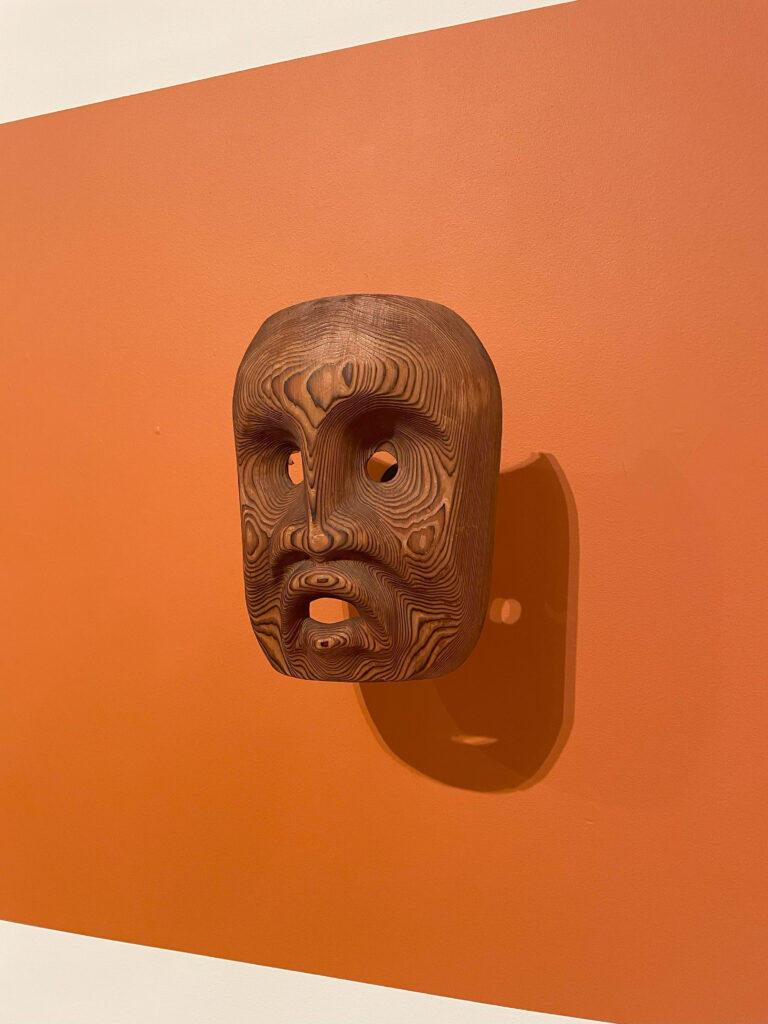
As I explore the exhibit I am struck by the different styles, colours and overall feel of the pieces. Some artworks are more traditional, whereas others bridge the past and the present in new and intriguing ways. I was immediately drawn to the “Wild Woman of the Woods”, unpainted, mask carvings of the late Kwakwaka’wakw carver Ellen Neel. The tight lines of the burnt cedar almost create an optical illusion as you study the way Neel has used the markings to bring out striking facial features like their pursed lips and sunken eyes.
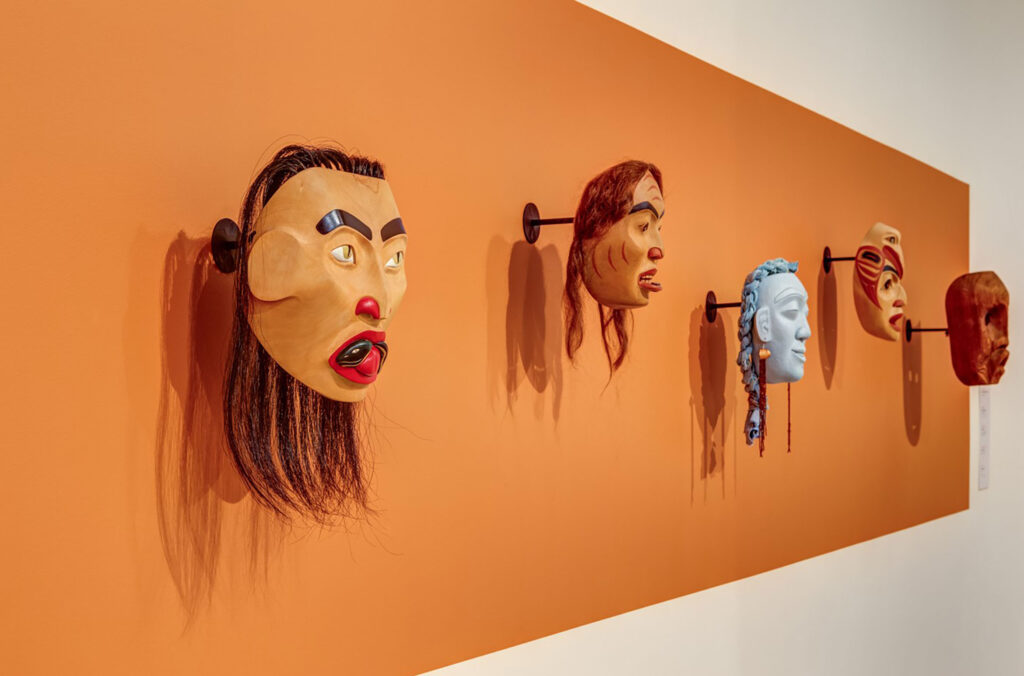
I was also drawn to the unique, contemporary works of Cherish Alexander, who graduated in the first class of the Freda Diesing School of Northwest Coast Art. She works with alder for its softness, and her supernatural-being pieces are paradoxically beautiful and ferocious.
Cori Savard’s pieces Bear in Human Form and Becoming Eagle Spirit (2018, alder, pigment) are examples of foundational Haida design merged with the artist’s distinct sense of style. Savard had two multi-year apprenticeships with mentors Reg Davidson and Ben Davidson who have been instrumental in her development, and she’s looking forward to passing that built-upon knowledge on to the next generation of carvers.
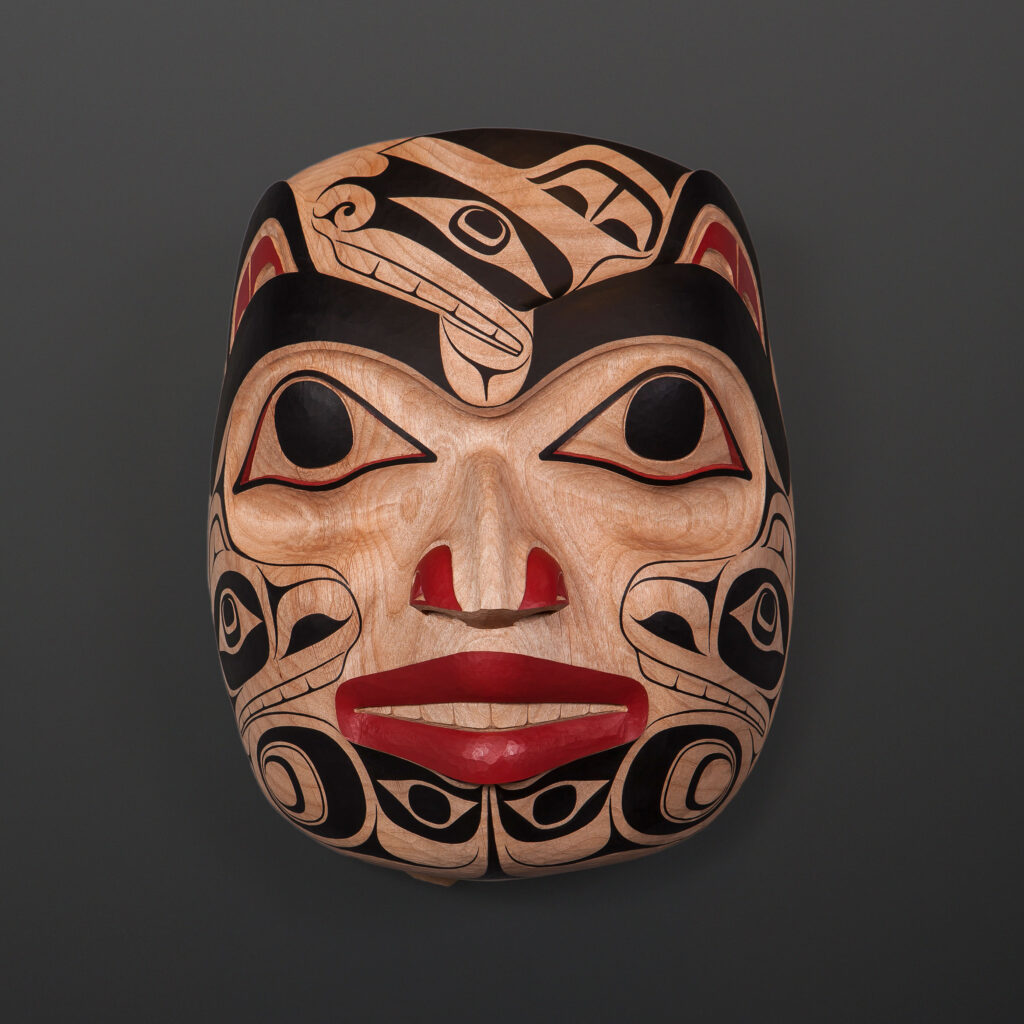
“Like most civilizations in the world today, we have moved beyond relegated gender roles within our culture. Men weave, women carve, everyone hunts, fishes, harvests, and contributes in the ways they are most gifted.” – Cori Savard – quote from the exhibit’s dedicated book by Figure.1 publishing, available for purchase at the Audain Art Museum.
After my first visit to this exhibit with its 127 pieces of work, I knew it wasn’t my last. I was drawn to these carvings, their stories and the women who brought them to life. The next time I visited I took my three girls with me. Armed with sketchpads and pencils they sat at the foot of a sculpture by Coast Salish artist, Susan Point Gift for Quiquil Comb (2003, red cedar, copper, pigment) attempting to copy the curves, shapes and designs.
View this post on Instagram
In frustration, one of them threw down their pad – she couldn’t get it right. Carver, Marika Swan’s words from the first pages of the exhibit book came into my mind.
“The chase for the perfect curve is the obsession of artists who pursue North-West Coast art. Each edge has to ride just the right tension. It can’t be too slack or too straight. It becomes then a process of slowly refining elements so that each feature rises and falls to meet the other.” Marika Swan – a quote from the exhibit’s dedicated book by Figure.1 publishing, available for purchase at the Audain Art Museum.
I consoled my daughter with the learnings of the 14 Indigenous women that surrounded us. These things take time, determination and perseverance, and in the case of this exhibit, in more ways than one.
View this post on Instagram
CURVE! Women Carvers on the Northwest Coast is a very special exhibit, housed in the stunning Audain Art Museum which also has an impressive permanent art collection of nearly 200 pieces taking you on a visual journey through the history of art from coastal British Columbia. It’s a must-do for culture lovers visiting Whistler, alongside the Squamish Lil’wat Cultural Centre, just a few minute’s stroll away down the Valley Trail.
Header Image: Joern Rohde